

ORDERING
O1: How secure is your web site for online purchases? Will my credit card information be safe?
Answer O1: Our e-commerce site is hosted by BigCommerce. BigCommerce operates as a PCI DSS Level 1 Service Provider and Level 1 Merchant. Your credit card information is sent encrypted to their computers from your browser via HTTPS. After your order is processed, no credit card information is retained by either BigCommerce or BoatZincs.com.
O2: Do you accept debit cards?
Answer O2: Yes, we accept debit cards for purchases online. However, please be aware of the following limitations imposed by your debit card issuer as explained by the Federal Trade Commission:
Customers who use debit cards for on-line transactions will find that when they place their order, their debit card is “authorized/blocked” for the exact amount of the transaction. When the vendor ships the order, the customer’s debit card is credited with the sale. The authorize/block is a common banking procedure. It may look like two separate transactions if you view your debit card account on-line immediately after the vendor ships your order. These two transactions most likely will resolve themselves in a day or two and the initial authorized/blocked amount will disappear. Sometimes, it may take up to 15 days, especially if you changed your order after placing it and the credited amount is different. If you have limited funds in your checking account, overdrafts may occur.
O3: How are your prices so low?
Answer O3: You’re probably wondering “How can you charge so much less?” than other marine product stores and still be in business, right?
- First of all, we sell only boat anodes. We specialize in the distribution of just one type of marine product. We know boat anodes A to Z. This product knowledge makes us very customer-responsive and cost-efficient. Need an anchor for your boat? Well, go back to Google.
- Second, we buy tons of boat anodes. They arrive at our shipping dock transported on tractor trailer trucks dispatched from the foundries. We use our volume purchasing power to get you the lowest possible prices.
- And, third, we run a tight ship. We spend our marketing budget carefully to ensure every advertising dollar pays for itself. We streamline our order processing system by asking you to enter your own order (thanks!). And we don't waste money on unnecessary things like mailing out product catalogues.
The result... We're proud to tell you we're a small but profitable company that expects to be in business for many years to come. This is due to having value-conscious customers like you.
We’re passionate about our boat anode business and we hope it shows.
O4: One of the products I need is listed as temporarily unavailable. Will it hold up the rest of my order?
Answer O4: Yes. By default, we ship all orders complete. If you require a partial shipment, let us know.
O5: I’m in a hurry. Can I pick-up my order?
Answer O5: Yes. Select "Customer Pickup” on your order as the shipping method and tell us when you need it. We’ll have it waiting for you at our warehouse at 569 Main Street, Hudson, MA 01749.
O6: Can I call to place an order?
Answer O6: Yes, please call anytime! We take many, many telephone orders and can be reached at 978-841-9978.
TECHNICAL
T1: Do your products meet Mil-Spec?
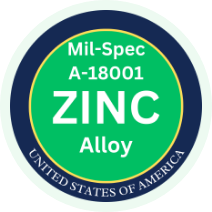
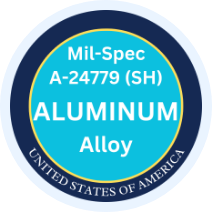
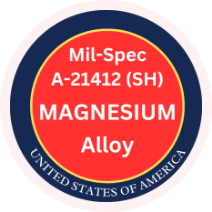
Answer T1: Yes! Sacrificial anodes must be impurity-free to properly work, and all our anodes are made only from Mil-Spec alloys. Learn more about the importance of Mil-Spec A-18001K for corrosion protection of your boat. Our zinc anodes are also compliant to ASTM B418 Type 1. Our Aluminum anodes conform to Mil-Spec A-24779(SH), and our Magnesium anodes conform to Mil-Spec A-21412(SH).
T2: How much zinc do I need on my vessel or underwater metal structure?
Answer T2: There are two dimensions to this topic.
- First, the larger the surface area of an anode, the higher its electrical current capacity and galvanic holding voltage. For most boats, you want your anode surface area to be sufficient to maintain all underwater metals between -850 mV and -1100 mV relative to a silver/silver-chloride reference electrode.
- Second, the longevity of a sacrificial anode is a function of its weight -- the greater the weight the longer its life.
Due to differences in water salinity, temperature, stray currents, and other external influences, you only know the right weight by actual trial. Periodically inspect your zincs, and when they have corroded to under 50% their original weight they should be replaced. To lengthen the replacement interval, increase the weight of zincs used.
If you have a steel or aluminum hull vessel that operates in salt water, use our Calculation Formula and/or give us a call. We've designed hundreds of corrosion protection solutions for vessels and underwater metal structures such as docks, boat lifts, and retaining walls.
T3: How can I tell if I have too little (or too much) corrosion protection on my boat?
Answer T3: The best way is to measure it. With a silver/silver chloride reference electrode it is relatively easy to get highly accurate voltage readings from all your underwater metals and determine if they are corroding or not. Take our Corrosion Quiz!
T4: The installation of boat anodes looks pretty straightforward. Could I be overlooking anything?
Answer T4: Make sure your anodes have good physical and electrical connections. An anode with a poor electrical connection cannot provide corrosion protection. Clean the area where your anode will be mounted by lightly sanding or wire brushing. Also, do not paint your anodes as they cannot perform unless exposed to water. Covering anodes with bottom paint renders them useless.
T5: What is the best position for anodes on my propeller shaft(s)?
Answer T5: For corrosion protection, it makes no difference where you locate your shaft anodes along the length of a propeller shaft. Any location is perfectly fine. However, the manufacturers of propeller shafts recommend zinc anodes be placed the distance of "one hand width" (i.e., 4 inches) in front of the aft cutlass bearing. This ensures adequate water flow through the bearing and, secondly, minimizes the shaft anode(s) weight contributing to shaft vibration on high performance boats.
T6: What are the technical differences between zinc, aluminum and magnesium anodes?
Answer T6: The intrinsic characteristics of the three different anode metal alloys used in the marine environment are listed below:
|
Anode Alloy
|
Voltage(1)
|
Density
|
Energy
Capacity |
Relative Life
to Zinc |
|
Zinc
(Mil-A-18001K) |
-1040mV
|
0.258 lbs/in3
|
368 A-h/lb
|
100%
|
|
Aluminum
(Mil-A-24779SH) |
-1100mV
|
0.105 lbs/in3
|
1108 A-h/lb
|
120%
|
|
Magnesium
(Mil-A-21412) |
-1600 mV
|
0.063 lbs/in3
|
500 A-h/lb
|
25%
|
| (1) Open circuit galvanic voltage produced relative to a silver/silver-chloride electrode in seawater. |
||||
T7: Which anodes should I use: Zinc, Aluminum or Magnesium?
Answer T7: Your choice of anodes requires consideration of:
- The kinds of underwater metals on your boat (e.g., stainless steel, bronze, aluminum, mild steel); and,
- The kinds of water you operate your boat in (e.g., salt, brackish and/or fresh).
Mil-Spec Zinc is the traditional anode choice for saltwater vessels.
Mil-Spec Aluminum anodes are for use in all types of water: Salt, Brackish, and Fresh. They are an alternative to zinc anodes as they are 1) more active, 2) provide better self-cleaning performance, and 3) offer a longer service life. They are preferred for protecting vessels with marine grade aluminum underwater metals.
Mil-Spec Magnesium anodes are the best choice for fresh water vessels (only).
T8: What is “bonding”?
Answer T8: The purpose of a bonding system is to ensure that metals on your boat are at the same voltage potential. This provides two major benefits:
- Electrical safety for the above water metals, and
- Corrosion protection for the underwater metals.
When bonded, underwater metals cannot be damaged by stray electrical currents originating from within the boat (e.g., a defective bilge pump, float switch or wire splice). When the bonding system is connected to sacrificial anodes, all bonded underwater metals are then protected against galvanic corrosion.
T9: How can I check my bonding system?
Answer T9: When your boat is on dry land, it’s simple. Use a digital ohmmeter with very long leads. Connect one lead to any ‘underwater’ metal in your bonding system (e.g, hull zinc anode). Then successively connect the other lead to each and every other underwater metal connected to your bonding system and verify a reading of 1 ohm or less (ideally a perfect circuit near 0.01 ohm.) Do not include the resistance of the ohmmeter leads themselves.
T10: What is that hard scale covering my zinc anodes? Do I need to remove it?
Answer T10: The hard scale commonly found on the surface of zinc anodes is Zinc Carbonate (ZnCO3). Carbonate (CO3) occurs in all bodies of water and originates from atmospheric carbon dioxide gas (CO2) naturally dissolving into the water. In general you do not need to be concerned about this scale as it only affects the maximum output amperage of the anode, not the anode’s required trickle output necessary to maintain effective corrosion protection. Zinc Carbonate is water insoluble, but can be readily removed by either alkalies or acids.
T11: What happens to zinc anodes used in fresh water?
Answer T11: Zinc anodes used in fresh water will over time develop a hard coating that causes the anode to become inactive and ineffective. This is known as 'passivation'.
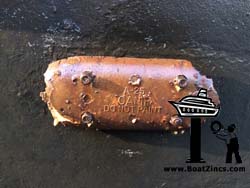
Aluminum and magnesium anodes offer superior self-cleaning performance and are your best choice for boats docked/moored in fresh water.
T12: Where do I attach magnesium anodes to a metal vessel in freshwater?
Answer T12: In freshwater the electrical conductivity of ions is 50+ times lower than seawater. This means that magnesium anodes need to be distributed underwater around the hull of a metal vessel for them to provide effective corrosion protection. Distributing anodes will achieve a much higher level of corrosion protection than simply bulk installing them on a boat's transom (a technique which works fine for most pleasurecraft in seawater). The conductivity of freshwater is highly variable as it is a function of the concentration of dissolved solids produced by the underlying geology. So, envision an individual magnesium anode in “freshwater” as offering a 2-meter radius of protection to the underwater metal that it's bonded to. For the last 18 years, BoatZincs.com's rule-of-thumb recommendation is to place magnesium anodes around the perimeter of a metal vessel no further than 4 meters (12 feet) apart.
T13: What is a galvanic isolator? What does it do?
Answer T13: Learn the purpose of galvanic isolators, their proper installation, and methods to test the isolator with commonly available equipment.
SHIPPING
S1: How do I calculate an expedited shipping rate on your site?
Answer S1: If you need quicker service, those options are available on the Shopping Cart page under ORDER SUMMARY either on the right-side of the screen on a desktop computer or just below the cart on a mobile device. You must first select your Country, then State, and enter City and zip code. Then click on ESTIMATE SHIPPING. A list will appear below and you can select the speed of delivery you need.
PLEASE NOTE: EXPEDITED ORDERS PLACED AFTER 4 PM ON FRIDAY WILL SHIP OUT ON MONDAY. BoatZincs.com, Inc. is closed on Saturday and Sunday and does not ship.
Shipping fees will apply if you select expedited service and your order is over $100.00. You must click ESTIMATE SHIPPING to see the rates, then click on UPDATE SHIPPING COST and PROCEED TO CHECKOUT to complete order.
S2: I am outside the US, what do I select for shipping?
Answer S2: We ship to Canada, Europe, Asia, and many other locations outside of the United States. To calculate the international shipping rate, once you place the items you want in your shopping cart, while in the shopping cart, select your Country, then State, and enter City and postal code, click on ESTIMATE SHIPPING, then select one of the shipping options shown: International Mail, UPS or DHL, then click UPDATE SHIPPING COST.
Shipping fees do apply for international service. You must click UPDATE SHIPPING COST to see the rates.
Note: BoatZincs.com does not pay the associated duties, taxes, and tariffs of international purchasers. The individual purchaser is responsible for these charges.
S3: How do I find the status of my order?
Answer S3: Immediately after you submit your order an Order Confirmation will be sent to your email address. Shortly after, you will receive a second email that confirms the shipment and provides a tracking number that can be used to monitor the shipment's progress at www.usps.com or www.ups.com. USPS tracking numbers start with "9405", while UPS Ground tracking numbers start with "1Z0A" or 1ZB6. International mail packages start with "CJ".
S4: Many e-commerce stores are eager to take orders but then can't deliver. Are your products stocked and shipped from your own physical inventory?
Answer S4: Yes, we are a store in the literal sense. We maintain an extensive physical inventory of every product we sell (except Commercial Anodes which ship direct from our foundries) so that we can ship immediately to you. Should we run out of a particular item, we immediately list it on our website. If you have any questions or concerns about our ability to ship your order, call us at 978-841-9978.
S5: Which do you recommend: UPS Ground or USPS Priority Mail?
Answer S5: United Parcel Service (UPS) specializes in the reliable delivery of packages like ours. Late in 2004, the United States Postal Service (USPS) introduced a package delivery service called ‘Priority Mail Flat Rate Box’ that many of our customers find attractive.
As to which carrier to use – it’s your choice, not ours (unless of course you place an order over $100 with free shipping - then we ship the fastest and most economical way). During checkout, you can compare the shipping fees. Here are the pros and cons of each service as we see them:
UPS Ground
+ Long history of reliable package deliveries + Often less expensive for orders going less than 250 miles + Often less expensive for orders over $100.00 + Late-day ordering (pick-up at 5:00 PM ET) + Online tracking of packages at www.ups.com — No Saturday deliveries (M-F only) — No PO Box deliveriesUSPS Priority Mail Flat Rate Box
+ Often less expensive for orders under $100.00 and going over 250 miles + Often faster delivery for orders going over 2,000 miles — New parcel service implemented by letter carriers — Restrictive packaging -- only a few different box sizes permitted — Harder to track package until it is deliveredS6: When will my order ship?
Answer S6: It is our policy to ship every order complete within 24 hours of its receipt. Orders received by us before 4:00 PM ET ship that day.
S7: What’s the best way to ship to Alaska, Hawaii, Puerto Rico, Guam, and the US Virgin Islands?
Answer S7: USPS Priority Mail is the best option for shipping to Alaska, Guam, Hawaii, Puerto Rico, and the US Virgin Islands. From your checkout page, select "AK", "GU", "HI", “PR” or “VI” as the State and “United States” as the Country. This will allow you to complete your order.
If you prefer to use one of UPS' expedited services, that's fine, but you must enter your address a little differently. See chart below for examples:
| CITY | STATE | COUNTRY TO SELECT | UPS NEXT DAY AIR | UPS 2ND DAY AIR | UPS WORLDWIDE EXPEDITED |
| Valdez | AK | United States | X | X | |
| Honolulu | HI | United States | X | X | |
| San Juan | PR | Puerto Rico | X | X | |
| St. John | VI | Virgin Islands (US) | X | ||
| St. Croix | VI | Virgin Islands (US) | X | ||
| St. Thomas | VI | Virgin Islands (US) | X |
Other expedited shipping options include USPS Express Mail, FedEx and DHL.
Email us for a quote.
S8: I’m in Mexico, what’s the best way to get my order?
Answer S8: Unfortunately, International Mail service to customers in Mexico has proven to be very, very unreliable, so we ship to Mexico only using the UPS Worldwide service. However, delivery via FedEx or DHL can also be made simply by contacting our office by phone or email for a price quote.
S9: What is your "Free Shipping Over $100" policy?
Answer S9: Free Shipping Policy: To receive free shipping, orders must be $100.00 net and ship to an address in the United States. For orders that qualify for free shipping, we reserve the right to select the most economical shipping method, using either UPS Ground or USPS Priority Mail. Expedited shipments and shipments outside of the United States do not qualify for free shipping. Commercial anodes and special orders do not qualify for free shipping.
S10: What are UPS "address correction" fees?
Answer S10: UPS charges $21.00 for any address they feel is incorrect based on their database. This includes missing business name, missing apartment number, missing suite number, incorrect street number, etc. Unfortunately, BoatZincs.com must pass on the charge for an address correction to the customer that placed the order. Please verify your shipping address before submitting your order.
RETURNS
R1: What is your return policy?
Answer R1: Customer Satisfaction is the highest priority job here at BoatZincs.com. It really is, as without satisfied customers we indeed have nothing.
If you are not 100% satisfied with any of our merchandise for any reason simply return it to us within 21 days and we’ll issue you a full refund (less shipping). The refund is for return of merchandise only and does not include any shipping charges you have incurred, including our cost of "free shipping" if the balance of your order falls under our $100.00 free shipping policy.
After 21 days, we will issue a store credit towards a subsequent purchase from our store. Please list your order number on the front of any package you return in the form of RMA [Order Number].
Anodes that are returned may be assessed a 20% restocking fee to cover the costs associated with packaging, materials, and credit card processing fees. The actual cost of outbound shipping will also be deducted from any refund. If a package is refused, return shipping will be deducted from the amount refunded.
Please return the anodes to us at:
Returns Department (RMA # [Order Number])
BoatZincs.com, Inc.
569 Main Street
Hudson, MA 01749
Please Note: Commercial anodes and special orders are not returnable.
R2: What happens with your "Free Shipping For Orders Over $100" policy if I return anodes?
Answer R2: BoatZincs.com offers "Free Shipping For Orders Over $100.00". When an order over $100.00 is place, BoatZincs.com pays the cost of standard USPS Priority Mail or UPS Ground outbound shipping. When you return items from this order, even though you paid return shipping, BoatZincs.com still paid the original outbound shipping fee.
If your order falls below the $100.00 threshold for “free shipping”, BoatZincs.com will reduce your refund by the cost of the initial outbound shipping.
R3: What happens if I return oxidized anodes?
Answer R3: Returned merchandise must be in its original condition. Anodes that have oxidized due to exposure to water or weather may not be returned. We will not issue a refund for oxidized anodes that have been returned as they are unsaleable.
R4: Can I return special order anodes?
Answer R4: Commercial anodes and special orders are not returnable.